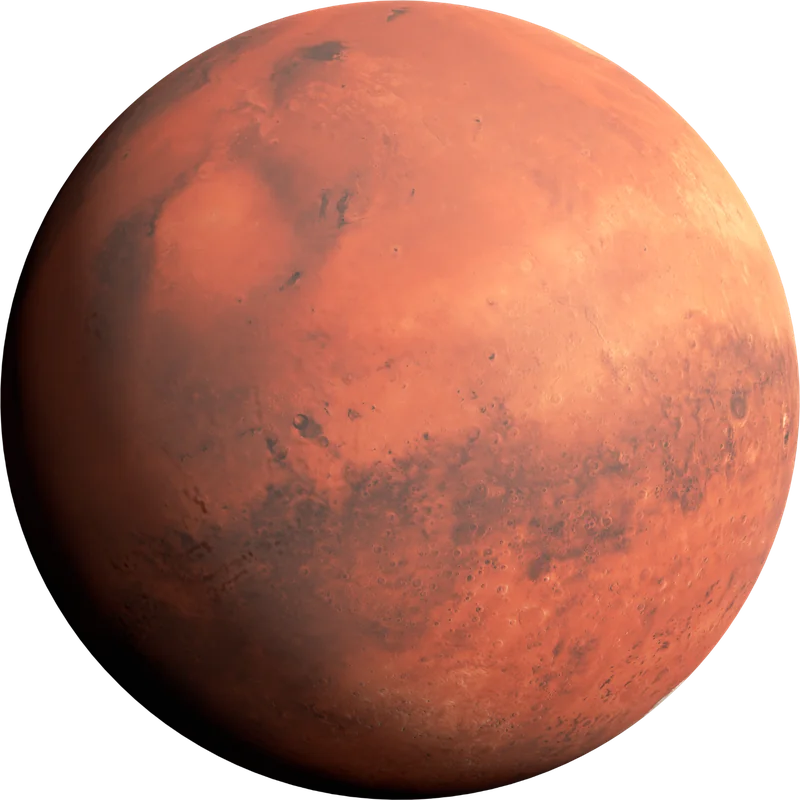
Why Your Age Would Be Different on Mars
Age, at its core, is just a count of how many times your planet has gone around the Sun since you were born. On Earth, that trip takes 365.25 days. We call that one year.
Mars takes longer. A lot longer.
According to NASA's planetary fact sheets, Mars completes one full orbit around the Sun in 686.97 Earth days — roughly 1.88 Earth years. That's based on decades of direct observation, spacecraft data from missions including Mars Global Surveyor and Mars Reconnaissance Orbiter, and orbital mechanics originally formalized by Johannes Kepler in his Third Law of Planetary Motion (1619).
So if you've been alive for, say, 10,950 Earth days (about 30 Earth years), you've only lived through 15.94 Martian years. On Mars, you'd still be in your mid-teens.
The Formula
Age on Mars = Total Earth days alive ÷ 686.97
Example: - Born: January 1, 1990 - Earth days alive (as of mid-2026): ~13,330 days - Mars age: 13,330 ÷ 686.97 = 19.4 Martian years
Every calculation on Cosmic Age Again uses this exact formula, with the orbital period sourced directly from NASA's Jet Propulsion Laboratory (JPL) planetary data.
What a Martian Year Actually Feels Like
A Martian year isn't just longer — it's stranger. Mars has seasons, just like Earth, because it also has an axial tilt (about 25.2°, compared to Earth's 23.4°). But because the orbit is longer and more elliptical, Martian seasons are uneven. Southern hemisphere summer on Mars lasts only 154 sols (Martian days), while northern hemisphere summer stretches to 194 sols.
A sol, by the way, is a Martian day: 24 hours and 37 minutes. Almost like Earth's day — just a little longer.
Your Next Mars Birthday
Here's where it gets genuinely fun. If you calculate your Mars age right now, you can find out exactly how many Earth days until your next Martian birthday — the moment you complete another full orbit around the Sun, Mars-style.
For most adults, that next Mars birthday is somewhere between 1 and 687 Earth days away.
Why This Matters (Beyond Being Fun)
Understanding orbital periods isn't just a curiosity — it's foundational to how we navigate space, plan missions, and even calibrate spacecraft clocks. When NASA engineers calculate a launch window to Mars, they're using the same orbital mechanics behind your Mars age.
The Mars 2020 mission (Perseverance rover) launched during a specific Earth-Mars alignment that only occurs every 26 months — because that's when the geometry of both orbits lines up favorably. That 26-month window? Directly derived from the synodic period of Mars relative to Earth.
Your Mars age connects you to that same math.